It is possible to receive both too much and too little attention at the same time. Think of Mondrian or Warhol: artists so famous they no longer need a first name, whose work appears on tea towels, posters and coffee mugs. Precisely because they are everywhere, it can seem as though nobody pays attention to the meaning of their work anymore.
A more recent victim of this celebrity paradox is singer Mariah Carey. Today, the general public mainly associates her with the Christmas hit All I Want for Christmas Is You, which has 2.5 billion streams on Spotify and will now be stuck in your head nonstop until 1 January 2027.
But in the last century, Carey was known as one of the world's most gifted vocalists, with a five-octave range and the ability to produce whistle notes so high that you might wonder whether they came from a dolphin or a bat. The world also seems to have forgotten that Carey is the solo artist with the most number-one hits ever: nineteen, eighteen of which she wrote herself.
This month, the singer celebrates the 25th anniversary of her eighth studio album, Glitter. That is by no means an occasion to be taken for granted. Glitter was the project that began Mariah Carey's fall from grace in 2001, reducing a pop genius to Christmas décor. For years, the album was therefore treated as taboo and was almost impossible to listen to.
Glitter was the soundtrack to a feature film of the same name, which was supposed to establish the singer as a movie star - something Whitney Houston and Jennifer Lopez had already managed to do. Both the album and the film were complete flops. Critics ridiculed Carey's acting ("Carey's performance in the lead role suggests that she has long since forgotten how non-famous people behave," wrote The A.V. Club) and panned the music.
This undoubtedly had something to do with the fact that the album was released on 9/11 - not an ideal moment for a soundtrack steeped in eighties nostalgia, full of synthesizers and glossy disco beats. (Still, Glitter did save someone's life: a woman named Sara Botkin was late for work at the South Tower because she had gone to buy the CD, narrowly missing the first plane by just a few minutes.) AllMusic called the album "the pop equivalent of Chernobyl". Q Magazine described it as a "downward spiral from talented to appalling, via unnecessary power ballads [...] and almost criminal covers", and placed it on its list of the worst albums ever made.
All this coincided with a classic celebrity breakdown, tracked minute by minute by the tabloids. It included an infamous appearance on MTV in a confused state, a series of incoherent messages on Carey's website and, eventually, admission to a psychiatric hospital. Her reputation was so badly damaged that Virgin Records paid Carey $28 million to terminate her contract and get rid of her: the ultimate humiliation for a musician.
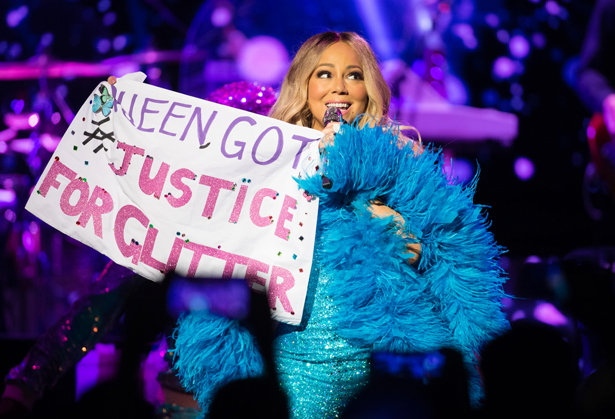
Carey owes it to her hardcore fans - who call themselves "lambs" - that this disastrous pile-up did not mark the definitive end of Glitter. In 2018, they launched the grassroots movement #JusticeforGlitter. Using the hashtag, they promoted the album on social media as a hidden gem that had been unfairly excluded from all streaming services.
Fan accounts urged people to buy Glitter en masse through iTunes instead. And did they ever: sales rose by 8,374 per cent, and the lambs even managed to catapult Glitter to number one on the iTunes chart. The fans were happy, Carey was happy, and traditional media were happy too. Since #JusticeforGlitter, the album has received positive coverage from outlets including Vanity Fair, GQ, Jezebel and The New Yorker.
This month's anniversary celebrations - which include a deluxe edition with fifteen extra tracks, a new vinyl release and a widely publicised reintroduction on Spotify - can be seen as the movement's climax.
This is not the first time fans have united to stand up for their idol. The #FreeBritney movement, for example, surfaced repeatedly over the past two decades, as fans tried to free Britney Spears from her father's conservatorship. Before that, around 2005, there was the Free Fiona movement, in which fans successfully campaigned for an album by Fiona Apple to be released after Sony Music had deemed it insufficiently commercial.
Hashtags did not yet exist, and Free Fiona's strategy relied mainly on collecting signatures through online forums and sending plastic apples to the record label - real fruit might have rotted in the mail.
#JusticeforGlitter differs from these earlier initiatives because it pursues not only a concrete objective (legal autonomy or the release of an album), but also a kind of paradigm shift. "Justice" means nothing less than setting things right, and in this case that means correcting the historical record: you professional music critics got it badly wrong; Glitter really was a good album all along.
This summer, the media were full of another example of fans interfering heavily in the lives of their idols: Ariana Grande announced that she was stepping back from the public eye. Not because an album had flopped, but because of the unstoppable avalanche of speculation about her significantly thinner body. Was she ill? Did she have an eating disorder? Was she deeply unhappy despite - or because of - her fame?
Grande's announcement sparked a debate about so-called "toxic empathy": comments that may be ill-intentioned or well-intentioned but are freely expressed under the guise of concern and eagerly shared on social media.
The tentative, provisional conclusion of that debate seems to be that judging someone for being thin also counts as body-shaming; that, in any case, we have no business passing judgment on women's bodies. In an article in The New Yorker, cultural critic Lauren Michele Jackson calls this conclusion unsatisfactory. Yes, the relationship between a star and a fan is parasocial: fans feel they know a star, but that feeling is based on fantasy, invention and projection. The public, of course, has no idea how Grande is really doing. Diagnosing her out of hand - with an eating disorder or anything else - is therefore harmful.
But Jackson argues that this does not mean we should stop critically examining our idols, including their appearance and the way they present themselves to us. We simply have to do it in the right way. "A good critic considers celebrities exemplary, never unique," Jackson writes. A good critic sees Ariana Grande as an example of broader social developments rather than as an exceptional case.
So a good critic does not ask: Is something wrong with Grande, and how can we tell by looking at her body? Instead, they ask: Why do we think a person's health can be read from their appearance, and why are we so eager to do so?
When Jackson writes about "the critic", she explicitly means both professionals and ordinary people. Today, anyone can join public debate with a post, share, comment or like on social media. This democratisation proved disastrous for Grande, but positive - even emancipatory - in the case of #JusticeforGlitter: fans challenged the tabloid narrative and corrected the verdict of traditional music journalists.
The question remains, however, whether #JusticeforGlitter is actually more reliable than the gossip about Grande's body. Anyone who resists being swept along by the movement and its aura of collective resistance may arrive at a more balanced assessment of Glitter in its anniversary year, 2026. Yes, the film really is terrible. No, the album is not - although it is certainly not Carey's best, either. Glitter lacks the one irresistible uptempo hit that all her previous albums had.
The album tries to do too much and at times feels choppy and overproduced. What is more, the layer of aesthetic sugar that you sometimes have to chew through in Carey's work to get to the gold (just consider the titles: the album before Glitter was called Rainbow, and the one before that Butterfly…) seems thicker in many places on Glitter than on the projects that came before and after it.
But the gold is definitely there. Take the beautiful "Lead the Way", a ballad about rediscovering hope in love. The song builds to a climax in an eighteen-second belt filled with melismas (a series of notes sung on a single syllable, ed.). Your heart would have to be made of stone not to be emotionally overwhelmed by it.
As a Carey fan, you also have to be made of stern stuff to resist the illusion that this is the real Mariah Carey you are hearing - that the person Mariah Carey reveals herself completely through the virtuosic rise and fall of that single, eighteen-second wordless belt.
The Mariah Carey who grew up in a dysfunctional, violent family, rejected by relatives because her parents' marriage was interracial and terrorised by neighbours. The woman who, at eighteen, began a relationship with the head of Sony Music, a man twenty years her senior; married him; and for years could not take a step without his approval. The artist whom her record label pushed towards saccharine pop while she herself wanted to move towards R&B. The woman who, in the run-up to Glitter, was under unprecedented pressure because she had left both her husband and Sony Music and had just signed an $80 million contract with Virgin Records - the biggest record deal in history at the time. The woman who did everything, absolutely everything, to make Glitter a success.
"A good critic considers celebrities exemplary, never unique," Jackson emphasised. Let Mariah Carey, then, be an example of resilience: of the extraordinary ability to write a ballad about hope and love even under the most appalling circumstances.
(Trouw)
|
|